Imagine looking up into the prehistoric sky and seeing an insect with a wingspan of 2.5 feet flying overhead.

It sounds impossible today — but around 275 million years ago, a giant dragonfly-like predator called Meganeuropsis permiana really did take to the skies.
The enormous insect lived during the late Permian Period, roughly 45 million years before the first dinosaurs appeared. Fossils suggest it was among the largest insects ever to exist, with wings stretching around 2.5 feet from tip to tip.
It may also have weighed roughly 450 grams — about a pound.
That is an astonishing size compared with modern insects, most of which can easily fit into the palm of a hand.

Scientists believe the unusually large insects of this ancient era may have been helped by environmental conditions that no longer exist. Atmospheric oxygen levels were significantly higher than today, while ecosystems lacked many of the predators and competitors that would later limit the size of flying insects.
Despite its dragonfly-like appearance, M. permiana wasn’t technically a dragonfly.
It belonged to an extinct group known as griffinflies, giant relatives of modern dragonflies and damselflies. One key difference can be seen in their wings: griffinflies had much more similar vein patterns between their front and rear wings.
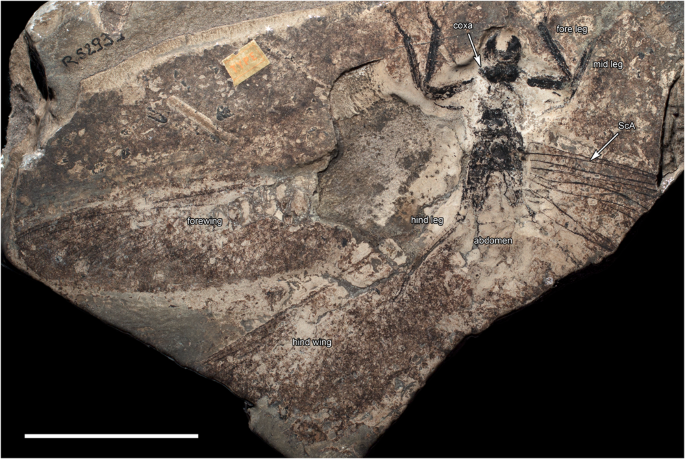
The species was first collected in Kansas in the late 1930s by paleoentomologist Frank M. Carpenter, with its primary fossil specimen now housed at the Museum of Comparative Zoology.
For millions of years, creatures like Meganeuropsis ruled an ancient world where insects could reach astonishing proportions.
Today, their descendants are tiny by comparison.
But the fossil record reveals that there was once a time when the sky belonged to giant insects.