A remarkable fossil has captured a prehistoric battle frozen in time — a badger-like mammal locked in a deadly struggle with a dinosaur roughly 125 million years ago.
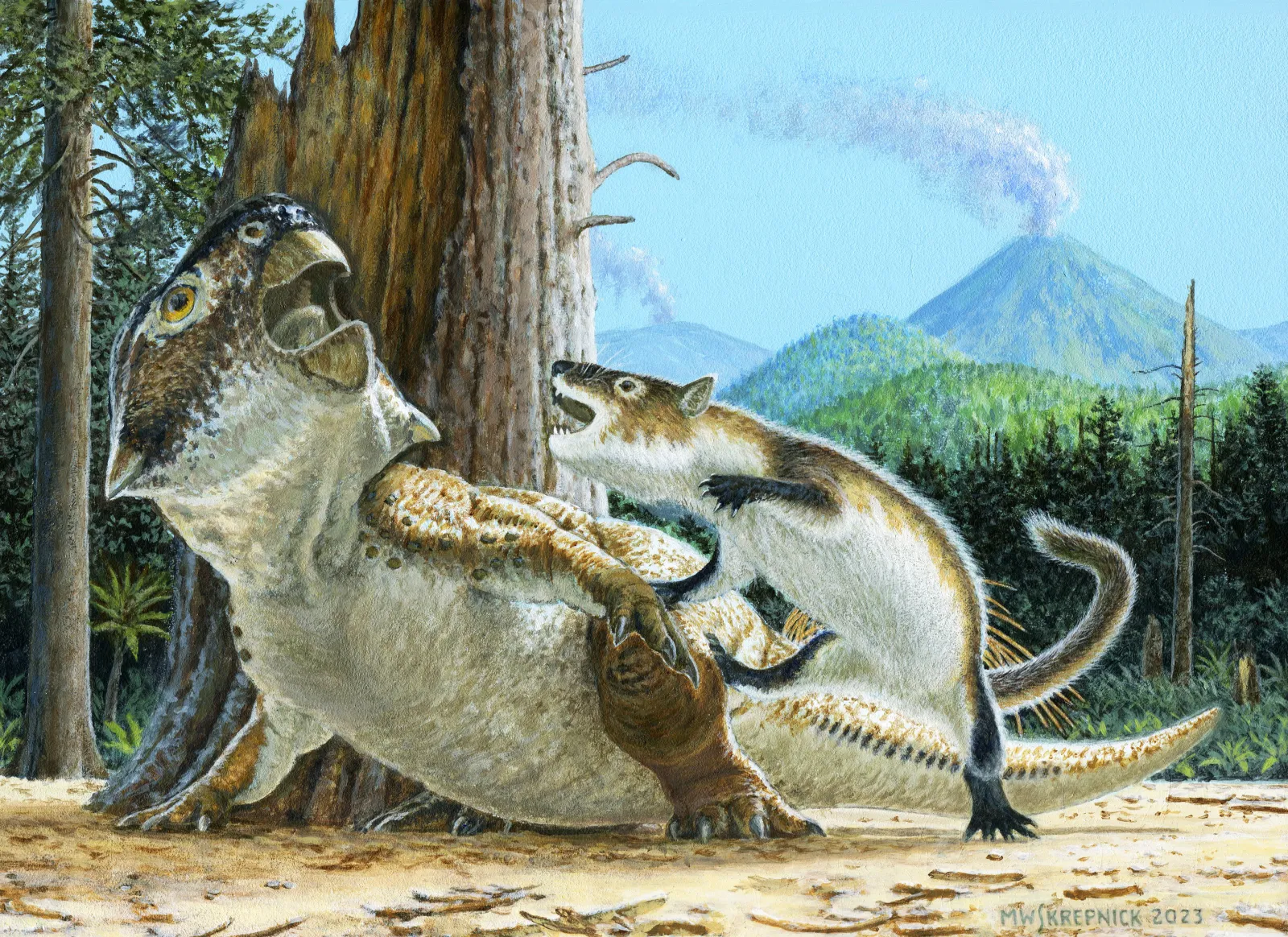
The extraordinary specimen shows Repenomamus robustus, one of the largest mammals known to have lived during the Cretaceous, apparently attacking a young Psittacosaurus, a plant-eating dinosaur roughly the size of a large dog.
But the most astonishing detail is where the mammal was found.
Its jaws were still clamped onto two of the dinosaur’s ribs, while its body remained intertwined with the dinosaur’s skeleton. The position of the animals provides rare evidence that the mammal was actively attacking the dinosaur when both were suddenly buried.
Scientists had previously suspected that Repenomamus preyed on dinosaurs because dinosaur bones had been discovered inside fossilized stomach contents. However, those remains could not prove how the animals came together.
This fossil is different.
Researchers believe the violent encounter was abruptly preserved by volcanic debris, mud and sediment, burying the animals before either could escape. The fossil site has been nicknamed “China’s Pompeii” because numerous animals were apparently entombed during catastrophic volcanic events.

Paleontologists also investigated whether the extraordinary specimen could have been assembled artificially. The intertwined skeletons and remarkable completeness of both animals supported the conclusion that the pair had been buried together.
The discovery challenges the simplistic image of dinosaurs as unquestioned rulers of the prehistoric world.
For at least one moment 125 million years ago, the hunter was not a dinosaur — it was a mammal with its jaws locked onto one.