It was small enough to fit in the palm of a hand, yet its skull preserved surprising similarities to one of the most fearsome predators ever to walk the Earth. A remarkable 120-million-year-old fossil from China is revealing how ancient birds retained unexpected features of their dinosaur ancestors.
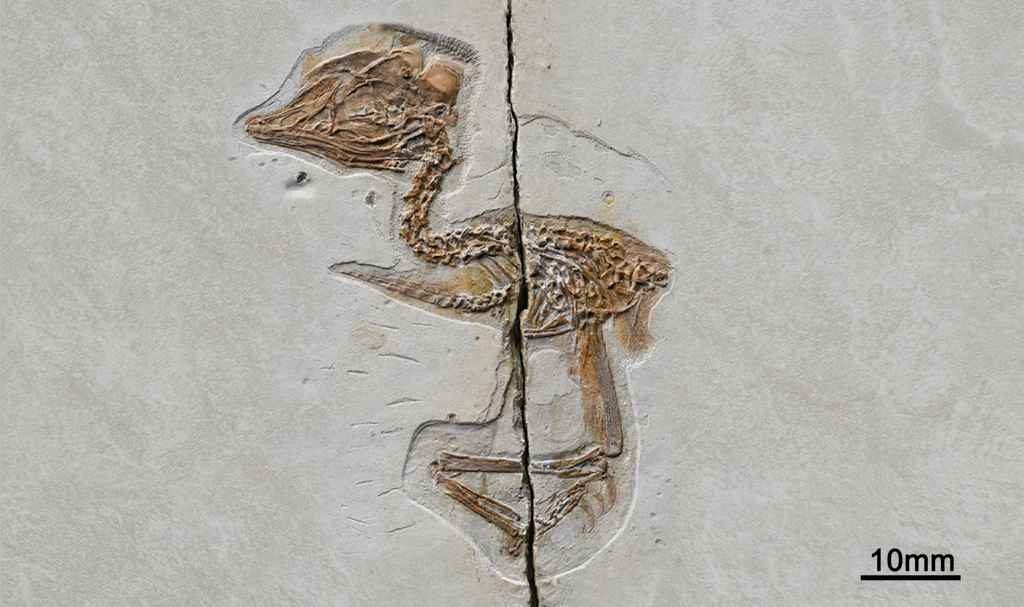
The partial skeleton was discovered in Liaoning Province in northeastern China, where the animal was buried in sediments deposited at the bottom of a shallow lake during the Cretaceous Period.
Researchers from the Institute of Vertebrate Paleontology and Paleoanthropology of the Chinese Academy of Sciences examined the fossil and identified a skull measuring just two centimeters, or about three-quarters of an inch long.

Despite its tiny size, the skull displayed several structural and functional features resembling those of Tyrannosaurus rex. The similarities suggest that early birds retained important aspects of their dinosaurian heritage, and their skulls may have functioned differently from those of modern birds.
Detailed analysis of the evolutionary relationships placed the animal among the enantiornithines, an extinct group often called “opposite birds.” These creatures represented the most diverse bird group during the age of dinosaurs and spread across much of the prehistoric world.

One important difference involves the quadrate bone, which plays a central role in skull movement. In living birds, this bone helps enable a specialized arrangement known as a kinetic skull, allowing the upper jaw to move independently of the braincase and lower jaw.
The fossil’s dinosaur-like characteristics offer a glimpse into an earlier stage of bird evolution, when features inherited from dinosaur ancestors remained prominent.
Rather than fitting neatly into our modern idea of a bird, this tiny creature preserves a more complicated evolutionary story—one in which the boundary between ancient dinosaurs and their feathered descendants was far less straightforward than it might appear.