🔥 Dylan Cease Silences Fenway With a 120-Pitch One-Hitter—And His Final Six Outs Have Blue Jays Fans Talking Cy Young

There are pitching performances that win games.
There are performances that rescue seasons.
Then there are afternoons when one pitcher takes complete control of an iconic ballpark and refuses to give the baseball back.
Dylan Cease delivered that kind of performance against the Boston Red Sox.
Nine innings.
One hit.
Twelve strikeouts.
A 6–0 Blue Jays victory—and a final sequence that made an already dominant outing feel even more extraordinary.
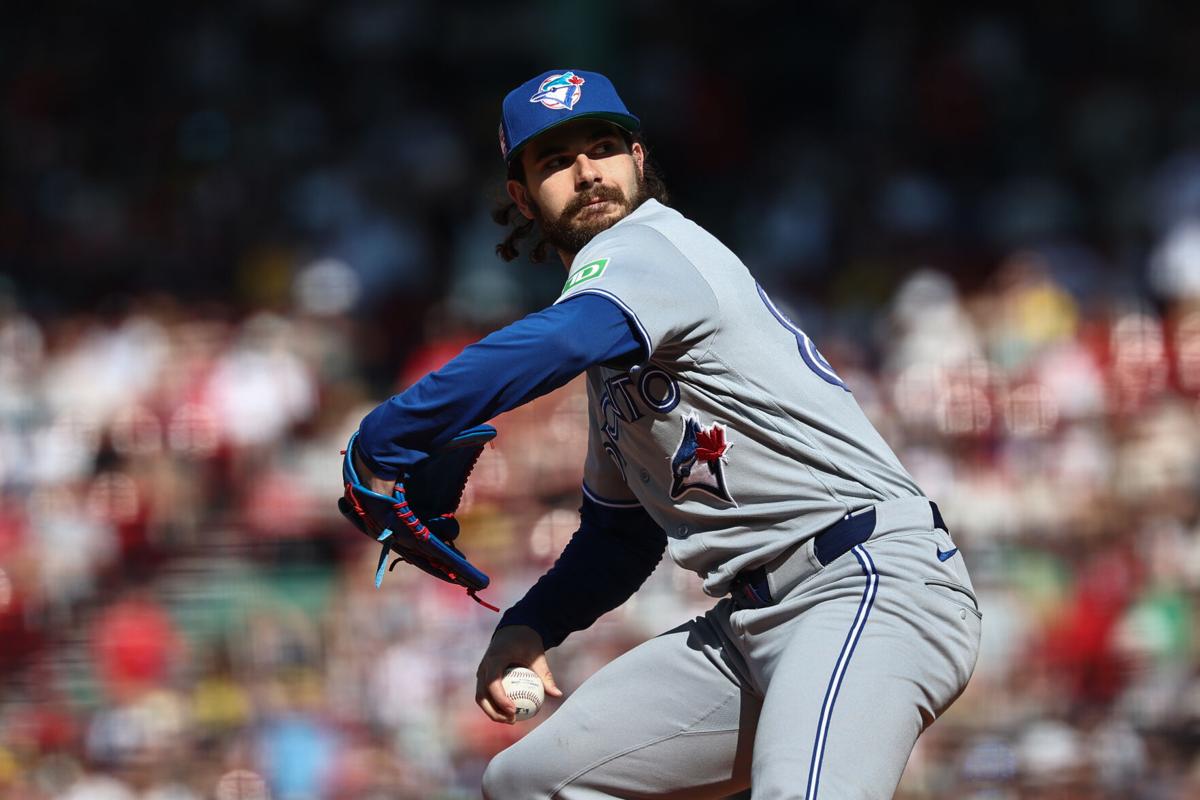
Toronto arrived at Fenway Park needing much more than another encouraging individual performance.
The Blue Jays had lost the series opener and entered Saturday facing uncomfortable questions about their record, their playoff position and their plans before the trade deadline.
Even after the victory, Toronto stood at 48–57 and six games behind the final American League wild-card position.
Cease could not answer every question surrounding the organization.
For one afternoon, however, he made all of them feel less urgent.
The first sign that something unusual might be happening was not encouraging.
Cease’s fastball sat below 94 mph during the opening inning, well beneath the upper-90s velocity that normally powers his arsenal.
His four-seamer eventually averaged 95.8 mph, compared with a season average of 97.6.
Cease later explained that his body felt “a little cranky,” although nothing was injured.
That forced him to pitch instead of simply overpowering hitters.
He changed speeds.
He trusted his secondary pitches.
He disrupted timing.
He allowed Boston’s hitters to keep waiting for velocity that was not arriving in its usual form.
The result was control disguised as adaptation.
Cease retired the first 14 Red Sox hitters before walking Caleb Durbin with two outs in the fifth inning.
Andruw Monasterio then ended the no-hit bid with a leadoff double in the sixth.
Fenway finally had a reason to believe Boston might break through.
Cease immediately took that belief away.

The double became Boston’s only hit of the game.
Only four Red Sox hitters reached base across nine innings, as Cease permitted the double and three walks while keeping every runner away from home plate.
The most remarkable part arrived when fatigue should have become impossible to hide.
His pitch count had climbed past 100.
His body had already forced him to work without his best velocity.
The Red Sox were seeing him for a third and fourth time.
None of it mattered.
Cease struck out the side in the eighth inning.
He returned for the ninth.
Three more Boston hitters came to the plate.
Three more Boston hitters struck out.
Six consecutive batters.
Six consecutive strikeouts.
No ball put in play over the final two innings.
With two outs in the ninth, Cease fired his career-high 120th pitch to Wilyer Abreu.
The pitch was called strike three, but an automated ball-strike challenge briefly interrupted the celebration.
Fenway waited.
Cease waited.
The call was confirmed.
He raised both arms, pumped his fist and watched his teammates run toward the mound.
His expression contained as much relief as celebration.
Cease later admitted he was tired and simply happy the game was over, while manager John Schneider praised the right-hander as a durable, “throwback pitcher” who deserved the opportunity to finish what he had started. Sportsnet’s postgame report documented the remarkable final pitch and the decision to leave him in the game.
Toronto’s offense made that decision easier.
The Blue Jays produced six consecutive hits during a five-run third inning against Boston starter Sonny Gray.
Vladimir Guerrero Jr. opened the scoring with an RBI single.
Ernie Clement doubled home another run.
George Springer then drove a three-run homer over the Green Monster, turning a tense afternoon into a 5–0 advantage.
Guerrero later added another RBI single to complete the scoring.
Toronto finished with 15 hits.
Boston finished with one. The official MLB recap confirmed both the offensive eruption and Cease’s final line.

Springer’s homer created separation.
Cease made sure Boston never found a path back.
That combination gave Toronto exactly what it needed one night after losing 6–4 to the Red Sox.
It also gave Blue Jays fans a performance that could not be reduced to an ordinary midseason victory.
The statistical line quickly gained attention online.
Nine innings and one hit would have been impressive enough.
Adding 12 strikeouts, six consecutive strikeouts to finish the game and a career-high workload transformed the afternoon into something much larger.
It was Toronto’s first one-hitter since Shaun Marcum held the Oakland Athletics to one hit in August 2010.
Cease also became the first Blue Jays pitcher to throw a complete-game shutout at Fenway Park since Roy Halladay accomplished it on September 30, 2009.
That was not an ordinary Halladay appearance.
It was his final start in a Blue Jays uniform.
Halladay allowed three hits in Toronto’s 12–0 victory and completed one last masterpiece before being traded to Philadelphia that winter. MLB’s Halladay retrospective identifies the Fenway shutout as the fitting conclusion to his Toronto career.

Cease now has four career complete-game shutouts, tied for the second-most in MLB since he debuted in 2019.
The comparison with Halladay does not mean Cease has already matched the legacy of one of the greatest pitchers in franchise history.
It shows how rarely modern pitchers are permitted to create nights like this.
Complete games have become uncommon.
A 120-pitch outing is even rarer.
A starter completing nine innings after entering the final frame above 100 pitches requires performance, trust and an unmistakable determination to finish.
Cease had all three.
The outing also strengthened his American League Cy Young case.
He ended the afternoon with a 2.46 ERA and 167 strikeouts across 113⅓ innings.
Yankees right-hander Cam Schlittler remained ahead with a 2.06 ERA, but Cease’s combination of strikeouts, workload and signature performances is becoming increasingly difficult to ignore.
This was also his second near-no-hit performance of July after carrying a no-hitter into the ninth inning against San Francisco on July 8.
One dominant start can become a headline.
Two in the same month can begin defining an award campaign.

Toronto’s larger problems have not disappeared.
The standings remain unforgiving.
The trade deadline remains close.
The Blue Jays still need an extended winning run to return seriously to the playoff race.
But every team searching for hope begins with a reason to believe the next game can be won.
Cease provided that reason.
One hundred twenty pitches.
One Boston hit.
Twelve strikeouts.
Six consecutive strikeouts to close Fenway’s door.
And one masterclass that reminded Blue Jays fans what a true ace can make possible.