A fossilized giant amphibian that lived 240 million years ago has been hiding in an extraordinarily unlikely place — inside rocks intended to build a garden retaining wall.
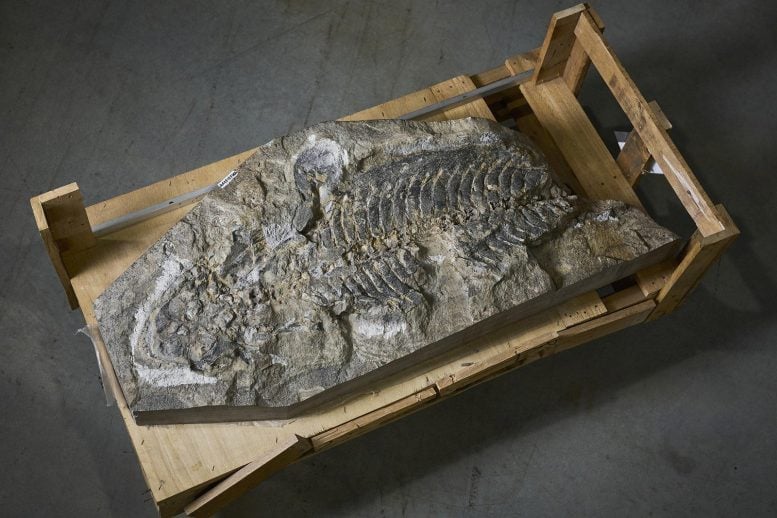
The remarkable fossil was discovered in the 1990s by a retired chicken farmer, who spotted it among rocks taken from a nearby quarry. The stones were destined to become part of a garden wall before the prehistoric remains were recognized and eventually donated to the Australian Museum in Sydney.
Decades later, scientists from the University of New South Wales and the Australian Museum have formally identified and described the ancient creature as Arenaerpeton supinatus — meaning “supine sand creeper.”
The fossil offers an astonishingly detailed glimpse into an animal that lived before and during the rise of the dinosaurs.
Nearly the animal’s entire skeleton is preserved, with its head and body still connected. But perhaps the most extraordinary feature is something far more delicate: the outlines of its skin can still be seen in the rock.
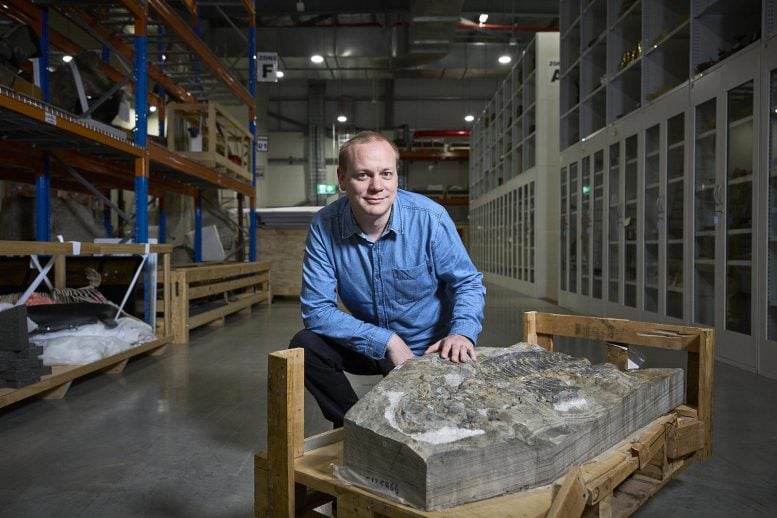
Palaeontologist Lachlan Hart described the specimen as a unique example of an extinct group known as temnospondyls.
Complete skeletons of ancient amphibians are already exceptionally rare. Finding one with the head and body attached is even more unusual — while preservation of soft tissue impressions is rarer still.

For millions of years, Arenaerpeton remained completely hidden inside the stone.
It was only by chance that its ancient body ended up being discovered by someone looking for building material.
What was supposed to become an ordinary garden wall instead turned out to contain a 240-million-year-old window into a world long before humans ever existed.