
Two paleontologists and an archeologist plaster a mysticete whale skeleton recently unearthed at a Scotts Valley construction site in preparation to move the bone
The past collided with the present in Scotts Valley when scientists discovered a whale fossil, as old as 4 million years, at a housing development site off Santas Village Road.
The bones were found Sept. 4, said Scott Armstrong, paleontologist with Paleo Solutions, a Los Angeles County-based archaeological consulting service assigned to the project.

“On some project sites, if a rock unit is known to have a high potential to produce it, then it’s typically outlined in the planning process and environmental impact report,” he said.
The potential was identified at the Scotts Valley project and a monitor assigned to follow construction vehicles found the fossil, Armstrong said.
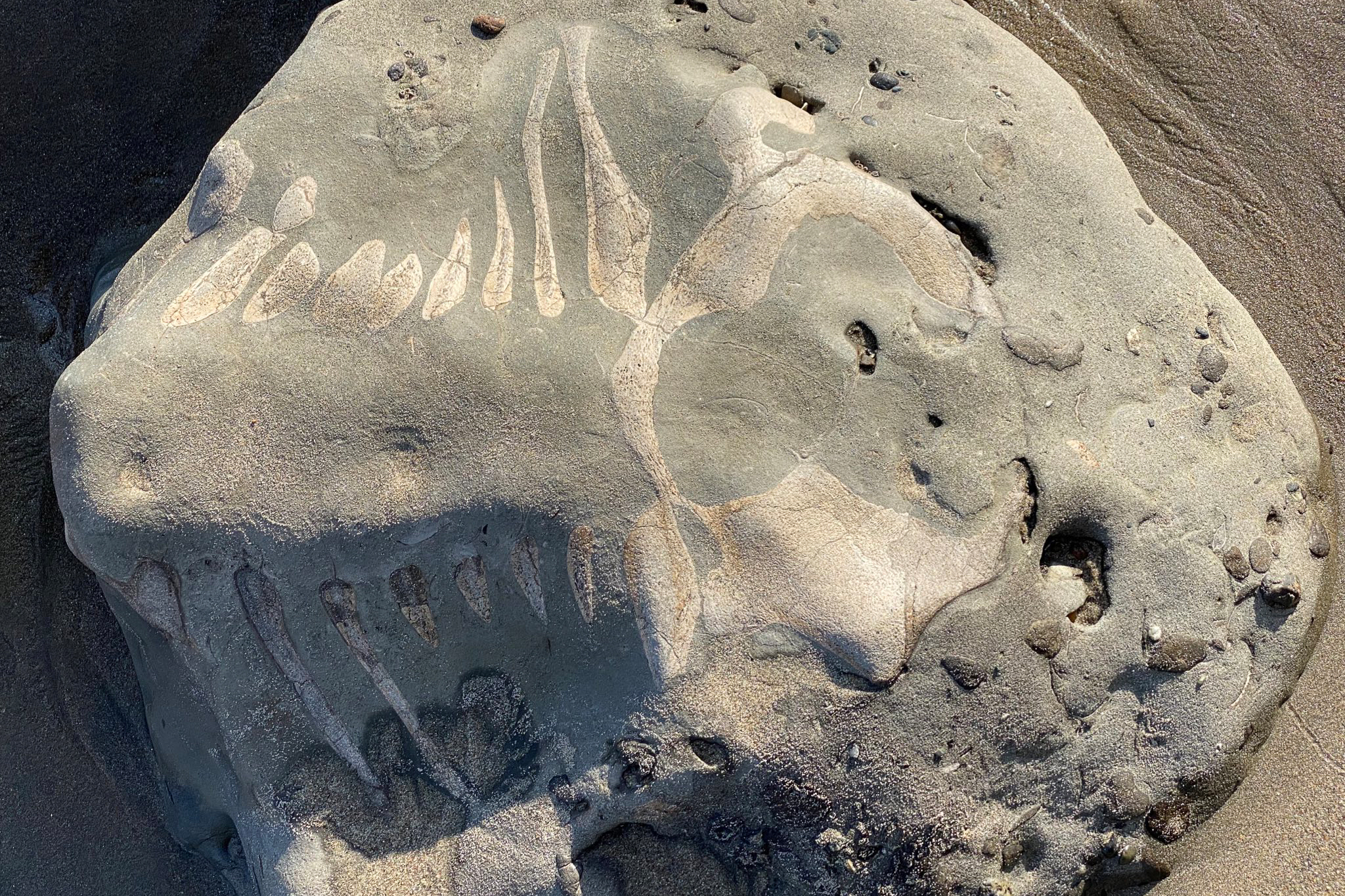
Thursday, amid the hum of trucks and backhoes, two paleontologists and an archaeologist, worked to dig out the fossil. Using hoes, shovels, brooms and smaller tools, the group slowly unearthed the artifact. Armstrong said the remains belong to a mysticete whale, an ancestor to the baleen whale. Estimated to be 25 feet long, the fossil is relatively intact, with pieces of the skull, much of the jaw, shoulder blades, arm bones and vertebrae found.

The bones in Scotts Valley made their way into the hills through earthquakes and shifting of tectonic plates, Armstrong said.
“Most places where you see a hill, somewhere there’s a fault line nearby pushing it up,” he said. “They’re relatively inactive faults. But yeah, it’s from lifting thousands, maybe millions of years ago.”
Scientists encased the bones in plaster to preserve the fossil’s integrity and make transport easier. The fossil will travel to Paleo Solutions’ office in Monrovia, in Southern California, where scientists will separate the fossil from the rock.
“If the bone is softer than the rock, it makes it very difficult because it’s hard to chip through the rock without breaking the softer bones, but we’ll get it,” he said.