For more than 110 million years, an extraordinary dinosaur lay hidden beneath the earth in what is now northern Alberta.

When researchers finally began preparing its remains, they discovered something almost impossible to imagine: the animal’s skin, scales and armored coverings had survived alongside its skeleton.
The dinosaur was Borealopelta markmitchelli, an armored plant-eater that lived during the Early Cretaceous Period.

Unlike most dinosaur fossils, which leave scientists with little more than bones, this remarkable specimen preserved the contours of the animal’s body in three dimensions. Individual scales could still be traced across its skin, while armor plates and horn-like keratinous coverings remained associated with the skeleton.

The fossil was discovered in March 2011 at the Suncor Millennium Mine near Fort McMurray. Heavy-equipment operator Shawn Funk noticed unusual material while excavating rock — unknowingly revealing a prehistoric animal that had remained buried for roughly 110 million years.
Its exceptional preservation eventually allowed scientists to investigate details normally lost forever, including the arrangement of scales and the coverings over its armor.
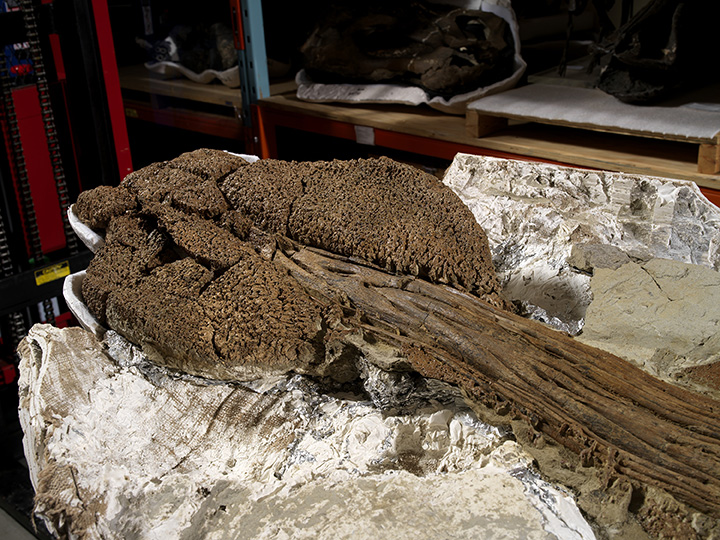
Despite being popularly described as a dinosaur “mummy,” the specimen does not contain intact internal organs. Its true significance lies in the extraordinary survival of skin, soft tissues, epidermal scales and keratinous structures.
It is a rare glimpse not simply of dinosaur bones, but of the animal’s actual body surface.
And after more than 110 million years in the darkness, this armored giant is giving scientists an astonishingly detailed look at what a dinosaur once looked like in life.