🚨 Trey Yesavage’s Knee Surgery Hits the Blue Jays at the Worst Possible Time — And the Next Few Weeks Could Decide Whether His Rookie Season Is Suddenly Over
There are injuries that cost a pitcher one start.
There are injuries that change a rotation.
And then there are injuries that force an organization to decide whether the future is worth risking for the present.
Trey Yesavage has undergone successful surgery to repair the meniscus in his left knee, leaving one of Toronto’s most important young arms officially week-to-week. The Blue Jays have not ruled him out for 2026—but they also cannot promise he will throw another meaningful pitch this season.
And that uncertainty may now become one of Toronto’s biggest decisions of August.
For a few seconds in Houston, nobody knew exactly what had happened.
Trey Yesavage had already worked through two innings against the Astros.
Then he returned to warm up for the third.
His left knee appeared to buckle.
The trainer came out.
Manager John Schneider followed.
And suddenly, one of the brightest young arms in Toronto’s rotation was walking away from the mound instead of throwing another pitch.
That was Aug. 4.
Now the uncertainty has become much more serious.
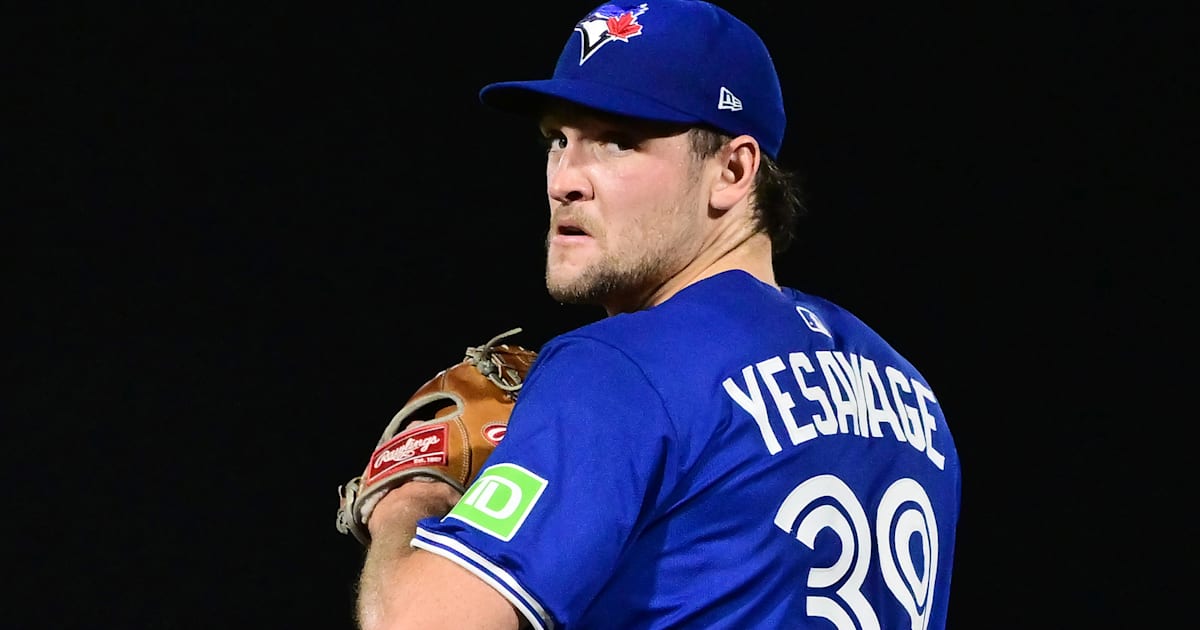
Yesavage has undergone successful surgery to repair the meniscus in his left knee, and the Blue Jays are describing the 23-year-old right-hander as week-to-week.

THE WORD “SURGERY” CHANGES THE ENTIRE FEEL OF THIS INJURY
At first, the injury was described as left knee discomfort.
Then imaging revealed the meniscus problem.
Now there has been surgery.
That progression alone explains why this situation suddenly feels much larger than a normal injured-list stint.
But there is one important piece of hope.
Toronto has not officially declared Yesavage finished for the season.
Schneider said the operation was successful and indicated that the club expects to understand much more about the timeline over the next couple of weeks.
His recovery will depend heavily on how the knee responds.
That leaves Toronto in a strange position.
The door is still open.
But nobody knows how wide.
YESAVAGE WASN’T JUST FILLING A ROTATION SPOT
This would be difficult enough if Toronto were losing an ordinary depth starter.
Yesavage had become much more than that.
Through 18 starts in 2026, the rookie had posted a 5-5 record with a 3.65 ERA while striking out 91 hitters across 93⅔ innings.
Those numbers represented more than production.
They represented progress.
Yesavage had already experienced the pressure of Toronto’s 2025 postseason run after making his major-league debut late that year.
He went 3-1 with a 3.58 ERA during that postseason as Toronto advanced to the World Series.
This season was supposed to be the next step.
More innings.
More responsibility.
More opportunities to establish himself as a real piece of Toronto’s future rotation.
Instead, one awkward moment during a warmup has interrupted everything.
AND TORONTO COULD HARDLY AFFORD ANOTHER ROTATION PROBLEM
The timing makes the injury even harder.
Kevin Gausman was dealt to the Chicago Cubs at the trade deadline.
Jameson Taillon, another arm Toronto had recently added, was placed on the 15-day injured list with right forearm tendinitis after leaving his Aug. 10 outing early.
Now Yesavage is recovering from knee surgery.
The Blue Jays are being forced deeper into their pitching depth at exactly the point in the season when stability matters most.
Toronto enters Aug. 12 at 57-63, fifth in the American League East and 3.5 games back in the wild-card race.
They are not mathematically finished.
But there is little room left for prolonged setbacks.
That makes Yesavage’s recovery timeline more than a medical question.
It could become a baseball decision.
WHAT HAPPENS IF HE CAN RETURN?
This is where the situation gets complicated.
Imagine Yesavage progresses quickly.
His knee responds.
He begins throwing again.
Late September becomes realistic.
Then Toronto has to answer a much harder question.
Should he actually come back?
Schneider has already said Yesavage will try to keep his arm active during the recovery process without placing strain on the lower body.
That could help preserve some pitching readiness.
But keeping an arm moving is very different from preparing a starting pitcher to face major-league hitters again.

If Toronto remains within striking distance of a playoff position, the temptation becomes obvious.
A healthy Yesavage could matter.
Every start could matter.
Every inning could matter.
But if the standings move sharply against Toronto, the equation changes.
What exactly would the Blue Jays gain by accelerating the comeback of a 23-year-old pitcher following meniscus surgery just to finish a losing season?
That is where short-term urgency runs directly into long-term responsibility.
THE NEXT FEW WEEKS COULD DECIDE EVERYTHING
There is no need for Toronto to make that call today.
That may be the most important part of Schneider’s update.
The Blue Jays can wait.
Watch the swelling.
Watch the strength return.
See how Yesavage responds.
Then reassess.
MLB currently lists his expected return as potentially before the end of the season, while emphasizing that Toronto is not yet ready to declare his year over.
That is hope.
But it is not a timetable.
And those are two very different things.

THIS IS BIGGER THAN ONE SEPTEMBER START
For Yesavage, there is an obvious competitive pull to return.
Pitchers want the ball.
Young players want to finish what they started.
A rookie who had already established himself in a major-league rotation naturally wants another opportunity to compete.
But Toronto has to think beyond September.
Yesavage is 23.
He was a first-round pick in 2024.
He has already shown he can perform in October.
And his first extended major-league season has provided the Blue Jays with another reason to believe he could become an important part of what comes next.
That changes the calculation.
One knee.
One surgery.
A few critical weeks of recovery.
And a season that is not officially over—but suddenly feels frighteningly close to the edge.
Toronto can hope Trey Yesavage pitches again in 2026.
The bigger question is whether, when the moment finally comes, bringing him back will still be worth the risk.