Jamie Carragher’s sharp critique of David Raya’s World Cup celebrations has ignited one of the more unusual debates in recent football memory, a clash of perspectives that goes beyond the pitch and into the heart of what it means to be part of a team. Carragher, never one to shy away from controversy, questioned how a goalkeeper who did not play a single minute in Spain’s historic triumph could celebrate with such intensity. His comments, delivered with the bluntness that has defined his punditry career, struck a nerve. “If he’s really among the best,” Carragher argued, “why didn’t Luis de la Fuente give him a chance?” That question has reverberated across social media, sparking heated exchanges between critics and defenders of Raya’s right to revel in the glory.
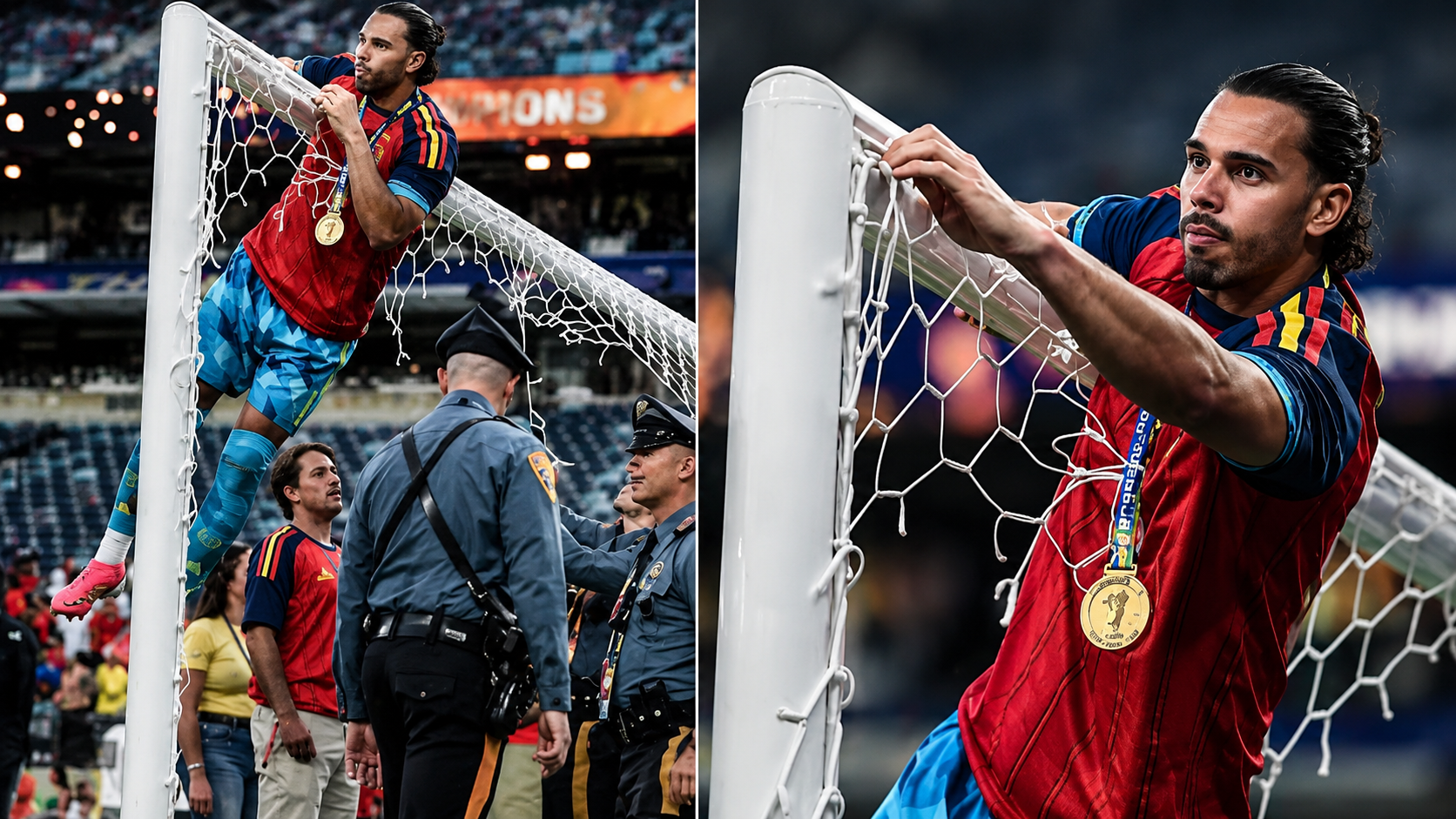
At the center of this storm is the image of Raya climbing onto the goalposts, arms raised in unrestrained joy, as Spain lifted the trophy. To Carragher, the sight seemed incongruous. He contrasted Raya’s exuberance with the more subdued celebrations of players like Rodri, Lamine Yamal, and Ferran Torres—stars who had carried Spain through the tournament with decisive performances. The implication was clear: those who fought on the pitch celebrated with restraint, while the man who watched from the bench let loose as if he had been the hero of the final. “It looked unusual,” Carragher said, “to see someone who never featured celebrating like that.” His words tapped into a long-standing tension in football about the roles of starters and substitutes, about who gets to claim ownership of victory.
Yet the counterargument is equally compelling, and it has been voiced passionately by fans and fellow professionals alike. Football, they insist, is not won by eleven men alone. It is a squad game, a collective effort that requires every player to train, prepare, and push teammates to their limits. Raya may not have stepped onto the pitch, but he was part of the daily grind, the unseen labor that keeps a team sharp and united. “Winning a World Cup is a 26-man achievement,” one supporter wrote. “Every player earns the right to celebrate, because without them, the team doesn’t function.” That sentiment reflects a broader truth about modern football: success is built not only on the brilliance of stars but on the depth and cohesion of the squad.

The debate also touches on the psychology of sport. For players who spend tournaments on the bench, the emotional release of victory can be even more intense. They live every moment in training, feel every ounce of pressure, and yet have no outlet on the pitch. When the final whistle blows, the joy is not just about winning—it is about validation, about proving that their sacrifices mattered. Raya’s celebrations, in this light, were not excessive but deeply human. “He celebrated like someone who had carried the weight of the team in silence,” one fan observed. “It was his moment too.” Such interpretations remind us that passion cannot be measured in minutes played.
Carragher’s comments, however, raise an important question about perception. In the eyes of the public, there is often a hierarchy of contribution. The goalscorers and playmakers are celebrated, while the squad players fade into the background. When someone like Raya breaks that mold with visible emotion, it challenges the narrative. It forces fans to reconsider what it means to be part of a triumph. Is the World Cup medal less valuable because it was earned without playing? Or does the medal itself erase those distinctions, placing every squad member on equal footing in history? The answer depends on how one views the essence of sport—as individual achievement or collective endeavor.

The controversy also reflects the changing culture of football fandom. Social media amplifies every gesture, every celebration, turning moments of joy into subjects of scrutiny. Raya’s climb onto the goalposts became a viral image, dissected and debated in ways that would have been unthinkable a generation ago. In this environment, players are judged not only by their performances but by how they express themselves. Carragher’s critique may have been rooted in traditional notions of merit, but the backlash against it shows how fans increasingly value inclusivity and collective spirit. “He deserved to celebrate,” one supporter tweeted. “Because football is about belonging, not just playing.”
For Raya himself, the debate may matter little. He is, officially and forever, a World Cup winner. His name will be etched into Spain’s history, alongside those who scored the goals and made the saves. That fact cannot be erased, no matter how many minutes he played. And perhaps that is the ultimate point: football’s greatest triumphs are shared. They belong to the entire squad, the coaching staff, the medical team, and the fans who carried the players with their belief. Raya’s celebrations, wild and unrestrained, were a reflection of that shared victory. They were a reminder that joy in football is not rationed by playing time but by the collective achievement of lifting the game’s most coveted prize.

Carragher’s words have divided opinion, but they have also sparked a valuable conversation about the meaning of contribution in sport. They have forced fans to confront the tension between visibility and value, between the heroes on the pitch and the ones who labor in the shadows. In the end, the debate is less about Raya himself than about the nature of football’s triumphs. His celebrations may have looked unusual to some, but to others they embodied the very spirit of the game—a spirit that insists victory is shared, that every member of the squad has earned the right to feel the weight of history and the joy of belonging.
What this debate ultimately reveals is the fragile balance between perception and reality in football. David Raya’s celebrations may have seemed excessive to some, but they also embodied the raw emotion of a player who had lived every moment of the tournament from within the squad, even if not on the pitch. In many ways, his joy was a reminder that football is not only about the visible contributions but also about the unseen sacrifices, the hours of training, and the spirit of unity that binds a team together. The storm around his celebrations has forced fans to confront uncomfortable questions about merit and recognition, but it has also highlighted the beauty of the game’s collective triumphs. Perhaps the true lesson is that history will not remember who played every minute or who sat on the bench—it will remember the team that lifted the trophy, and the shared humanity that made that victory possible.