“I REALLY WANTED TO GO TO MANCHESTER CITY…” — THE TRANSFER THAT NEVER HAPPENED, AND THE CAREER THAT COULD HAVE BEEN REWRITTEN
How Harry Kane, Tottenham Hotspur, and Manchester City collided in a summer that changed Premier League history — even without a signature
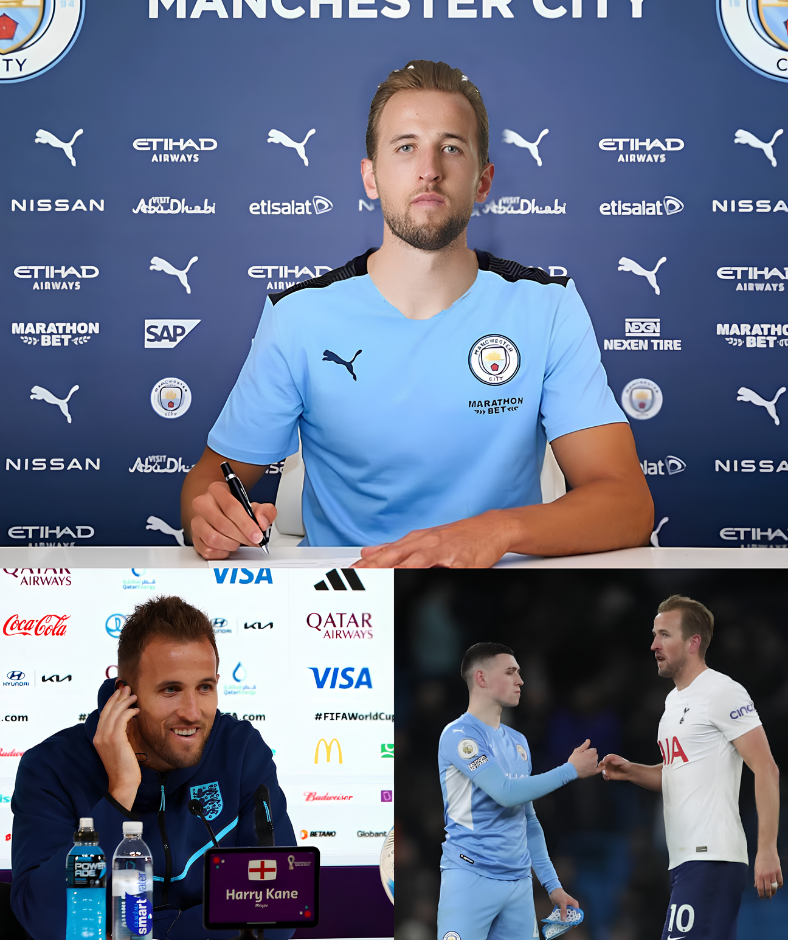
When Harry Kane finally allowed the words to surface years later — “I really wanted to go to Manchester City when I was playing in the Premier League but…” — it reopened one of modern football’s most debated transfer sagas. It was not just a deal that collapsed. It was a moment that may have quietly reshaped the balance of power in English football, and possibly Kane’s entire legacy.
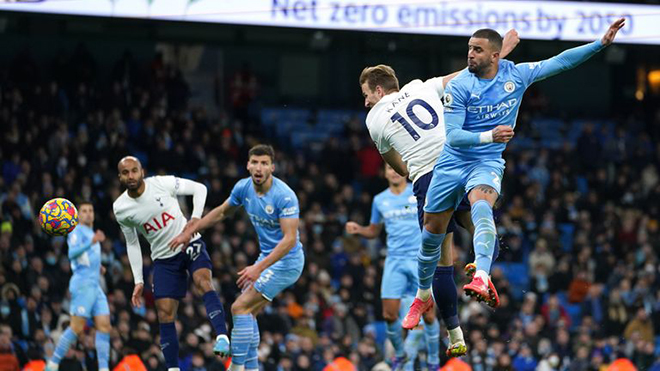
In the summer after the 2020–21 season, the departure of Sergio Agüero from Manchester City left a void that statistics alone could not measure.
Agüero had delivered title after title under Pep Guardiola, but the UEFA Champions League remained the missing jewel. City’s response was immediate and ruthless: find a striker who could guarantee goals at the highest level. Their primary target was clear — Kane, the most complete English centre-forward of his generation.
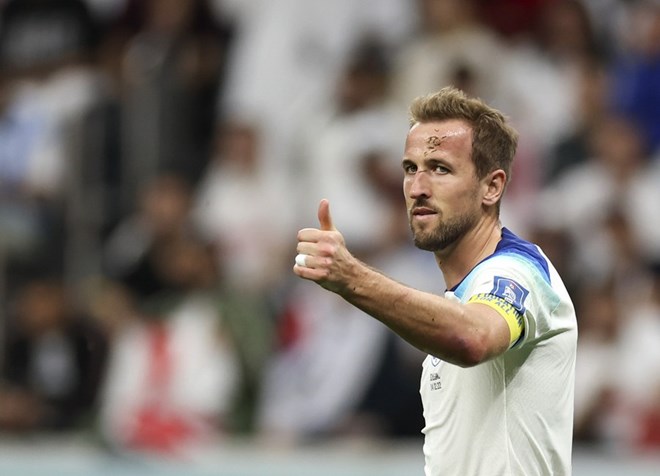
For Kane, the appeal was obvious. City were not just dominant; they were evolving into a tactical machine under Guardiola. Sources close to the situation at the time described direct conversations between Kane and Guardiola, in which the City manager laid out a simple vision: Kane as the undisputed No.9 in a side built to control Europe. It was, by all accounts, a role tailor-made for him — central, decisive, and surrounded by elite creators.
Yet football transfers are rarely decided on vision alone.
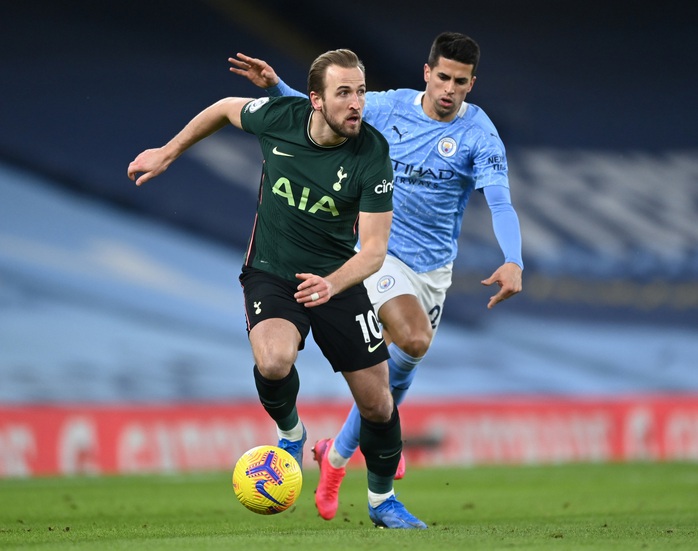
The obstacle was Tottenham Hotspur chairman Daniel Levy, whose negotiating stance has long been defined by precision, patience, and an unwillingness to be pressured into undervaluing his assets.
Tottenham did not simply resist; they set an internal valuation that City refused to meet. The result was a standoff that stretched across the entire transfer window.
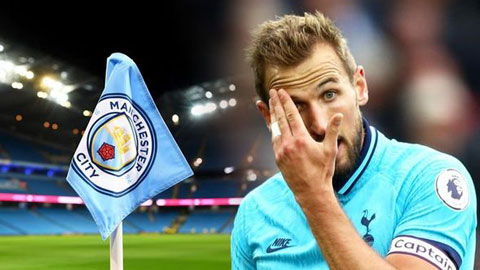
City pushed repeatedly. Kane, according to multiple reports from that period, made his desire known and was even absent from early pre-season preparations — a signal interpreted as frustration rather than rebellion. But Tottenham’s position did not shift. Levy’s message was consistent: Kane was not for sale unless the terms reflected both his sporting and symbolic value to the club.
As deadlines approached, negotiation fatigue set in. City had the financial power, but not the willingness to meet Tottenham’s final demands under pressure.
Tottenham had the leverage, but not the desire to lose their captain and record scorer without absolute control of the terms. When the window closed, no agreement existed.
The consequences were immediate and visible. Manchester City entered the season without a traditional centre-forward. Guardiola adapted, as he so often does, deploying fluid attacking rotations with Gabriel Jesus and false-nine structures. It worked — City remained dominant — but the absence of a pure striker in decisive Champions League moments became a recurring talking point, especially in matches where margins were razor-thin.
For Kane, the fallout was more personal than tactical. He remained at Tottenham, carrying expectation, goals, and leadership pressure in equal measure. Over time, the emotional weight of the failed move lingered in public discussion, even as he continued to score at an elite rate.
Eventually, after 14 years at Spurs and nearly a decade as their central figure, Kane made his long-awaited departure to Bayern Munich in 2023. The move was framed as a pursuit of silverware and a reset of career ambition. In Germany, his output was immediate and ruthless — he surpassed 100 goals for Bayern in a remarkably short span, reinforcing the belief that his prime years had been among the most efficient in Europe, even without major trophies in England.

But the debate around Kane’s legacy never truly disappeared.
Some argue that greatness in football is defined by moments on the biggest international stages. For Kane, that means the FIFA World Cup with England national football team and the possibility of a Ballon d’Or — the ultimate individual recognition in the sport. Others point out that sustained elite performance at Tottenham, a club outside the traditional elite trophy cycle, should itself qualify as legacy-defining excellence.
The “what if” scenario remains irresistible. Had Kane joined Manchester City in 2021, he would have entered a system engineered for attacking efficiency at its peak. Had he joined Real Madrid earlier in his career — especially after Cristiano Ronaldo’s departure in 2018 — his trophy cabinet might already look fundamentally different. These alternate histories are speculative, but they underline a truth about Kane’s career: timing has been as influential as talent.
So why didn’t the Manchester City move happen?

The answer is not mystery, but structure. Tottenham refused to sell on City’s terms. City refused to overpay beyond their internal valuation. Kane wanted the move, Guardiola wanted the player, but modern football often resolves such equations through leverage, not desire. In this case, Tottenham held it.
In the end, the transfer that never happened became a defining chapter in all three stories. City adapted and continued to win. Tottenham retained their star but remained trophyless in that era. Kane left later, still chasing the validation that might ultimately decide how history remembers him.
Because for all the goals, records, and accolades, the question still lingers — not whether Harry Kane is world-class, but whether football’s final verdict will depend on what he achieved, or what he narrowly missed becoming.