In the history of the NHL, debates about greatness often gravitate toward goal scorers, franchise forwards, and highlight-reel defensemen. But time and again, when dynasties are built and playoff series are decided in the tightest margins, the conversation circles back to a different kind of star: the goaltender.
Few positions in professional sports carry as much weight, and fewer still have produced as many era-defining figures as hockey’s last line of defense.
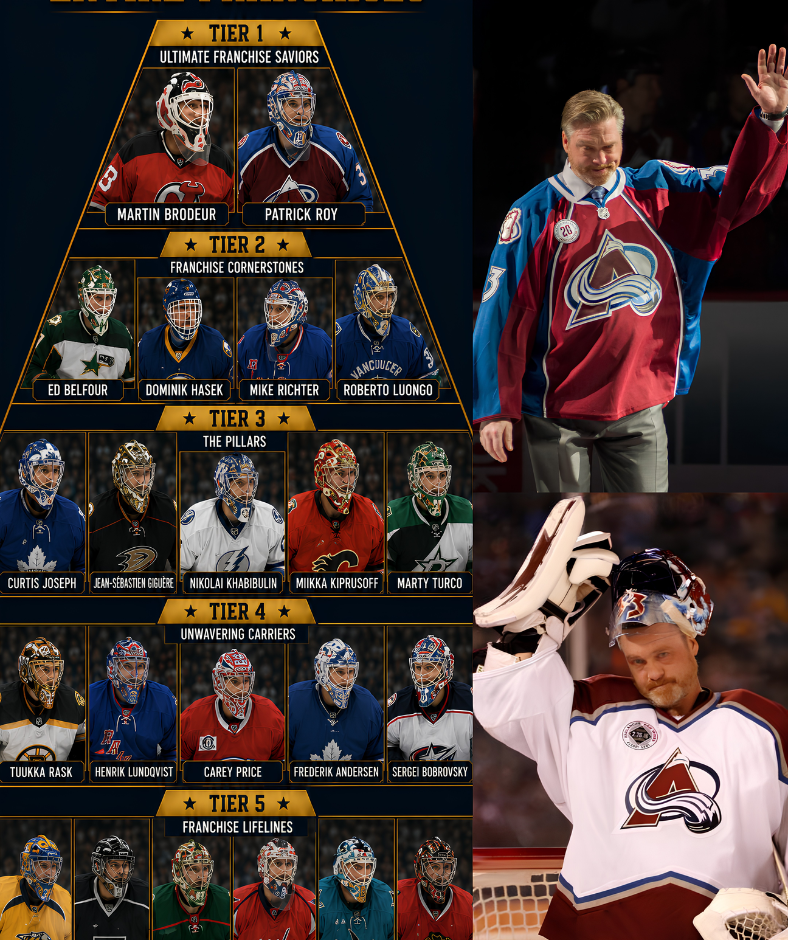
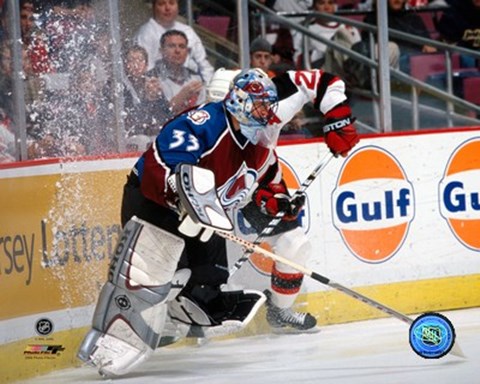
At the center of that discussion stands Patrick Roy, a goaltender whose career didn’t just define success—it helped reshape what success looked like. Roy didn’t simply win games; he altered expectations.
Across his time with the Montreal Canadiens and later the Colorado Avalanche, he built a reputation for elevating entire teams into championship contenders almost by sheer force of confidence and will. His four Stanley Cups, two with Montreal and two with Colorado, tell only part of the story.

The deeper truth lies in how he won them: with a combination of clutch playoff performances, psychological dominance over shooters, and a level of composure that made teammates believe no game was ever truly out of reach.
When Colorado acquired Roy in 1995, it was not just a trade—it was a transformation. Within months, the Avalanche became a Stanley Cup champion, with Roy delivering performances that set the tone for one of the most successful expansions in modern NHL history.

For many observers, that move cemented the idea that an elite goalie could instantly convert a good roster into a championship team.
But Roy is only one pillar of a broader historical argument.
If Roy represents intensity and playoff transformation, Martin Brodeur represents endurance and structural dominance. Brodeur didn’t just win; he sustained excellence over decades with the New Jersey Devils, becoming the backbone of one of the NHL’s most disciplined defensive dynasties.

His record-setting win totals and shutouts reflect not only individual brilliance but also system mastery. The Devils’ identity during his era was inseparable from his presence in net.
Then there is Dominik Hasek, a goaltender who redefined what was physically possible at the position. Known as “The Dominator,” Hasek turned chaos into control. His unconventional style—acrobatic, unpredictable, and instinct-driven—produced highlight saves that often defied logic. In Buffalo, he carried teams that were structurally average into legitimate contenders, proving that a single elite goaltender could bend competitive balance in ways few believed possible.

On the West Coast, Roberto Luongo brought a different form of excellence: stability under pressure. As the cornerstone of the Vancouver Canucks for nearly a decade, Luongo delivered consistency through long regular seasons and deep playoff expectations.
While his postseason narrative was complicated, his role in elevating Vancouver into a perennial contender remains undeniable. He gave the franchise an identity built on reliability in net.

In New York, Henrik Lundqvist became something more than a goaltender—he became a franchise symbol. For over a decade, Lundqvist kept the Rangers competitive in an unforgiving market, often masking roster deficiencies with elite-level performances. His combination of technical precision and calm under pressure made him one of the most respected netminders of his generation.
Meanwhile, in Montreal, Carey Price reached a peak that many analysts still describe as the most complete modern goaltending season ever played. At his best, Price didn’t just stop pucks—he controlled games. His 2014–15 season, in particular, showcased a rare blend of athleticism, positioning, and mental control that pushed the Canadiens into legitimate championship contention.
Others such as Jonathan Quick, Tuukka Rask, Pekka Rinne, Sergei Bobrovsky, Braden Holtby, and Corey Crawford each left their imprint on championship runs and franchise identities. Quick’s playoff explosiveness powered Los Angeles to multiple Cups.
Rask’s consistency anchored Boston’s modern era. Rinne defined Nashville’s rise. Holtby delivered Washington its long-awaited breakthrough. Crawford provided Chicago with stability during its dynasty years.
Yet despite this long list of greatness, the central question remains unresolved: which goaltender carried his team the most?
The answer depends on how “carry” is defined. If it means transforming an average roster into a contender overnight, Roy’s impact with Colorado stands unmatched. If it means sustaining excellence over the longest period while setting records, Brodeur’s résumé is difficult to surpass.
If it means elevating weaker teams beyond expectations through pure individual brilliance, Hasek’s peak may be the most influential. If it means consistent franchise stabilization over a decade, Lundqvist and Luongo both make compelling cases. And if it means reaching a level of peak performance that briefly redefined perfection in net, Price belongs firmly in the conversation.
In reality, the NHL’s greatest truth may be that no single answer exists. The goaltender position has evolved into a paradox: it is both deeply individual and inseparable from team structure. A great goalie can carry a team—but only within the system and moments that allow it.
Still, when championships are remembered and dynasties are discussed, one pattern repeats itself. The conversation inevitably drifts back to the crease. And there, behind the mask and pads, stand the figures who didn’t just defend the net—they defined entire eras of hockey.