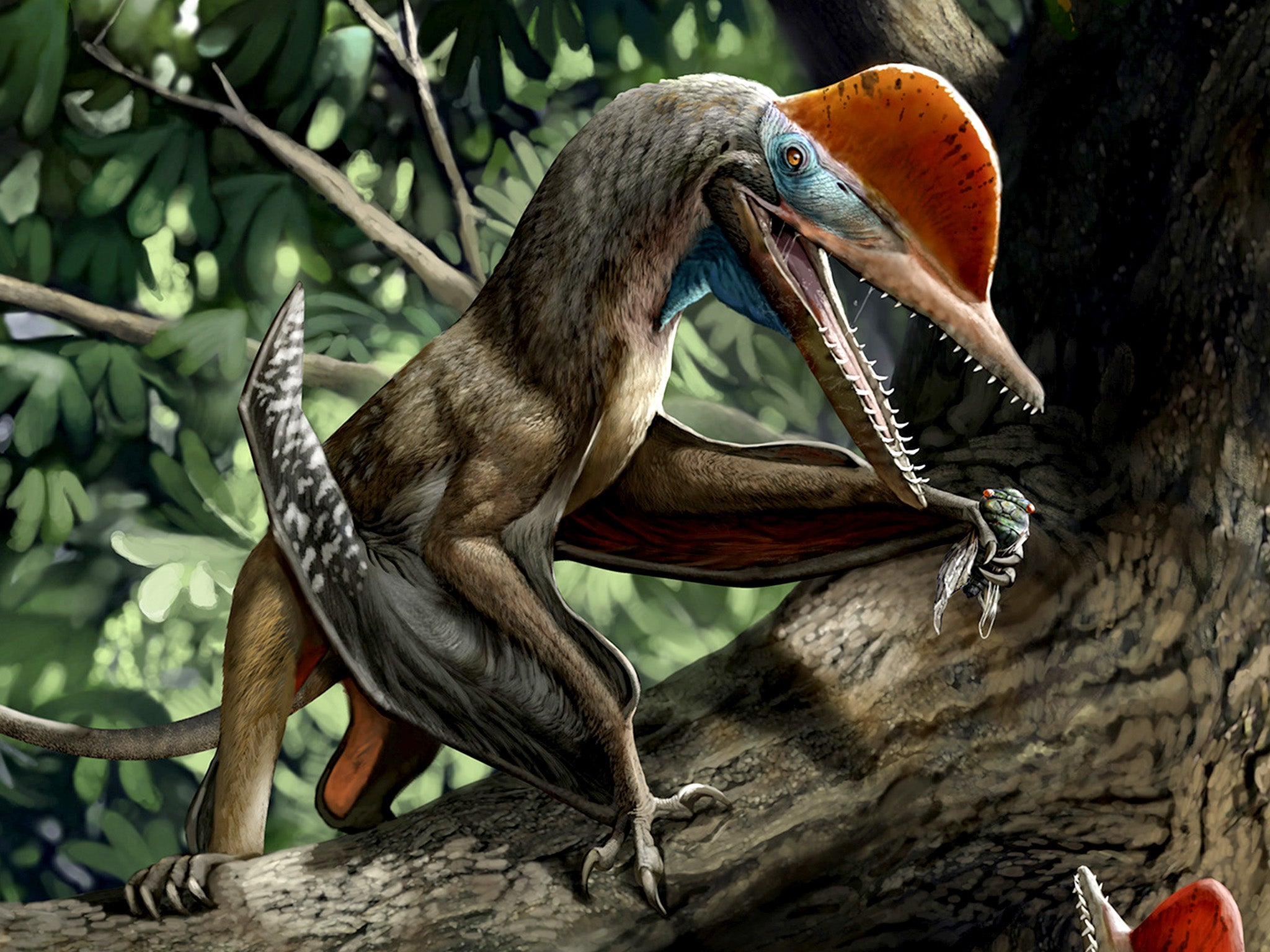
Paleontologists have discovered the first-known fossil of a flying dinosaur with opposable thumbs.
Nicknamed “Monkeydactyl”, the 160-million-year-old pterosaur likely used its dexterity to climb trees and hunt for insects and other prey.
![Species New to Science: [Paleontology • 2021] Kunpengopterus antipollicatus • A New Darwinopteran Pterosaur (Darwinoptera: Wukongopteridae) reveals Arborealism and An opposed Thumb](https://blogger.googleusercontent.com/img/b/R29vZ2xl/AVvXsEiippR8wRlW-Inp_REGKZ0zqX2Pojoqhee2Vxo0zkK9YTLc_ynxCziURwA7VNTSfeES1WlLTL2_SdNoOJCNjFGpLLxMrJ7m5K4mEsubKP-M_tGeAvtQrygzYRTfzIz0CXs5cvVw3sRrFwSH/s2048/Kunpengopteru_antipollicatus-novataxa_2021-Zhou_P%25C3%25AAgas_Ma_Han_et-al__%2540pegasaurus_42.jpg)
A team of international researchers unearthed the Jurassic remains in Liaoning, northeastern China, a hotbed for fossil discovery.
/https://tf-cmsv2-smithsonianmag-media.s3.amazonaws.com/filer/6a/ed/6aede57e-b7eb-4ff8-a43f-7c94eb1a504c/261712.jpg)
The monkeydactyl is the earliest known animal with the ability to touch the inside of its thumbs to the inside of its index fingers, according to the paleontologists behind the discovery.
Opposable thumbs are mostly found in mammals and some tree frogs. Chameleons are an extremely rare example of living reptiles with opposable thumbs.

Thanks to the use of a small CT scanner, scientists were able to create digital models of the monkeydactyl fossil and determine how the thumbs would have lined up with the other fingers.
Some scientists consider the ability to climb trees a missing evolutionary link which led to pterosaur flight.
![New information on the Wukongopteridae (Pterosauria) revealed by a new specimen from the Jurassic of China [PeerJ]](https://dfzljdn9uc3pi.cloudfront.net/2016/2177/1/fig-3-full.png)
The monkeydactyl is unique as it appears to have been able to do both, with a modest 33in wingspan allowing it to fly between trees.
Kunpengopterus antipollicatus, the monkeydactyl’s scientific name, is derived from words meaning “opposite” and “thumb” in ancient Greek.
Its unique physical structure places monkeydactyl in a group of pterosaurs known as darwinopterans, named after Charles Darwin due to their advancing contribution to the understanding of evolution.