A research project undertaken by the Complutense University of Madrid (UCM) and the Institute of Geoscience (IGEO, CSIC-UCM) identified various marine worms from the Paleozoic era (Ordovician period) 455 million years ago at the Tafilalt Biota site in Morocco. They correspond to the new genus and species Anguiscolex africanus, and the new species Wronascolex superstes.
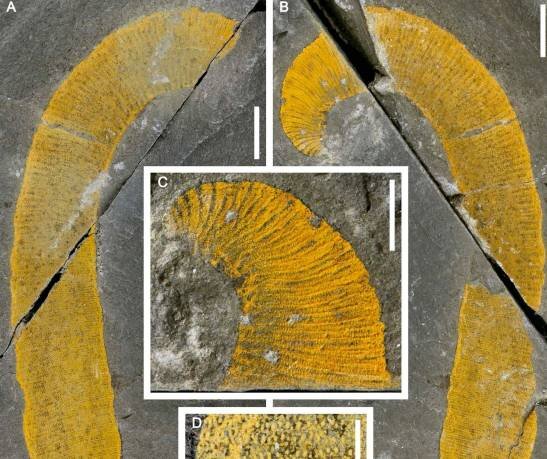
Palaeoscolecid worms are not rare in the Paleozoic; the problem is that 99.99% of the fossil record comprises their sclerites (hard plates embedded in the cuticle) in isolation, which typically build up in certain limestone rocks. In other words, this type of worm lived in all the seas of the globe, but there is no evidence of their fossils other than at a tiny fraction of sites.

The worm fossils at the Moroccan site were articulated and well preserved in lutites (fine-grained rocks) and in an environmental context dominated by turbulent waters, which makes the finding, according to the UCM and IGEO paleontologist Juan Carlos Gutiérrez Marco, a “paleontological surprise in a far from favorable geological context.”

The cuticle of these marine worms, described in Historical Biology, was covered in phosphatic microsclerites (measuring 20-100 thousandths of a millimeter), arranged in rings on the successive segments, their conservation being facilitated by rapid burying, having first been protected beneath bacterial veils which precipitated iron sulfides.
These two individuals are now added to the finding made some years ago, at the same site and by the same research team, of the worm Gamascolex vanroyi.